- Most club music sits between 120 and 140 BPM. House lives around 120-128, techno a little faster, trance faster again.
- Dubstep and EDM trap are written around 140-150 BPM but feel like 70-75 because the drums are half-time.
- Hip-hop, reggaeton and moombahton live in the 85-110 zone, which is why open-format DJs use them as the “slow lane” of a set.
- Treat every BPM chart as a guide. Sources disagree on the edges and tempos drift over the years.
Tempo is the first thing a DJ checks and the first decision a producer makes. Get it right and a track sits where the crowd expects it. Get it wrong and a house record feels sluggish or a moombahton edit feels rushed. This chart is the one I keep in my head when I build open-format sets that jump from hip-hop to house to bass music in the same hour.
The BPM chart
These are working ranges, not rules. Where published sources disagree, the range covers both.
| Genre | Typical BPM | Feels like | Notes |
|---|---|---|---|
| Hip-hop | 85-100 | As written | Modern trap-style hip-hop is often written at 130-160 and felt at half |
| Reggaeton / dancehall | 90-100 | As written | The dembow rhythm sits comfortably around 95 |
| Moombahton | 100-110 | As written | Born when Dave Nada slowed a 128 BPM Dutch house remix to 108 |
| Deep / soulful house | 118-124 | As written | Lower end of house, more space and groove |
| House / tech house | 120-128 | As written | Large tempo studies peak right at 128 |
| Bass house / big room | 124-130 | As written | Festival EDM clusters at 126-128 |
| Techno | 125-140 | As written | Hard techno has pushed well past 145 since 2021 |
| Trance | 128-145 | As written | Uplifting trance often 136-140 |
| Dubstep | 140-150 | 70-75 | Snare on beat 3 gives the half-time weight |
| EDM trap | 140-150 | 70-75 | Half-time hip-hop drums at festival scale |
| Drum & bass | 160-180 | 80-90 (half) | Modern tracks mostly 172-175 |
Two big tempo analyses back up the shape of this table: across tens of thousands of dance tracks, the distribution peaks at 128 BPM and most of the music falls between 120 and 140 (see sources).
Written tempo vs felt tempo
Every track has two tempos. The written tempo is what your DJ software shows. The felt tempo is where your body puts the beat. In dubstep the kick lands on beat 1 and the snare on beat 3, so a 140 BPM grid feels like 70. That is why a dubstep drop can feel slow and heavy while the hats are racing.
Why this matters in a set: because 140 is double 70, a dubstep or trap record locks onto a 70 BPM groove, and a 174 drum & bass track locks onto an 87 BPM hip-hop beat. The kicks line up, so the blend sounds intentional instead of like a train wreck.
The three tempo lanes in an open-format set
When I play open format I think in three lanes rather than a dozen genres:
- The slow lane (85-110): hip-hop, reggaeton, dancehall, moombahton. Big singalongs and recognizable vocals.
- The house lane (120-130): house, bass house, future house, big room. Where the night builds and holds energy.
- The heavy lane (140-150, felt at 70-75): dubstep, trap, riddim. The peak moments and the drops.
Most of my remixes exist to connect those lanes: a hip-hop classic flipped into 100 BPM moombahton, or a pop hook rebuilt as bass house, so the crowd hears something familiar while the tempo changes underneath.
How to move between tempos
Use the half-time bridge
Go from 140 dubstep to 70-ish hip-hop (or the reverse) on a clean phrase. Because the grids line up, you barely need to touch the pitch fader.
Ride the tempo slowly
Moving from 124 to 128 over a few tracks is invisible to a crowd. Jumps of more than about 6-8% start to make vocals sound chipmunked or dragged unless key lock is on.
Use a hard cut or a spinback
For big jumps, such as 100 to 128, a clean cut on the first beat of a drop or an echo-out sounds deliberate. Trying to beatmatch across that gap sounds messy.
Use a tempo-bridge edit
Some edits start at one tempo and end at another. These exist precisely so DJs can cross lanes without a cut.
When your software gets the BPM wrong
Analysis software regularly picks the wrong octave for half-time music: a 174 drum & bass track shows as 87, a 140 trap track shows as 70. Fix these in your library before the gig. Rekordbox, Serato and Traktor all let you double or halve the detected tempo, and a correct grid matters more than any chart.
Want to hear these lanes in action? My remixes and DJ sets jump between all three, and the free DJ Vault pack has edits tagged with BPM so you can test the transitions yourself. For keys, read the Camelot wheel guide.
FAQ
What BPM is house music?
Most house music sits between 120 and 128 BPM. Deep and soulful house sit lower, around 118-124, while bass house and big room cluster around 126-128.
Why does dubstep feel slow if it is 140 BPM?
Dubstep drums are half-time: the snare hits on beat 3 instead of beats 2 and 4, so a 140 BPM track feels like 70 BPM.
What BPM is moombahton?
Moombahton usually runs 100-110 BPM. It started when Dave Nada slowed a 128 BPM Dutch house remix down to 108 BPM in 2009.
Can you mix hip-hop into drum and bass?
Yes. A 174 BPM drum and bass track lines up with an 87 BPM hip-hop beat because 174 is exactly double 87.
Sources: Digital DJ Pool, DJ BPM Guide (2026) · Beat Kitchen, The Genre Landscape · Mixgraph, What BPM is Dubstep? · Aulart, Tempo in Ableton Live · Spin, Moombahton Goes Boom (2011)
// More guides
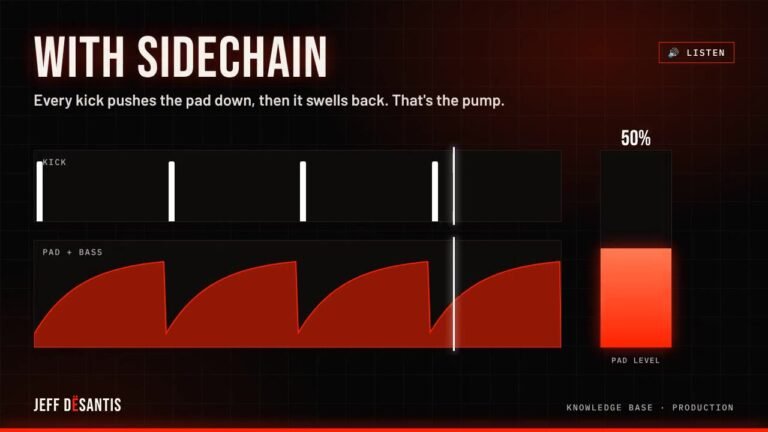 Music production · Video + audioSidechain Compression Explained: How to Get the EDM PumpHear the difference: what sidechain compression does, why every EDM drop pumps, and the four settings that control it.Watch & read →
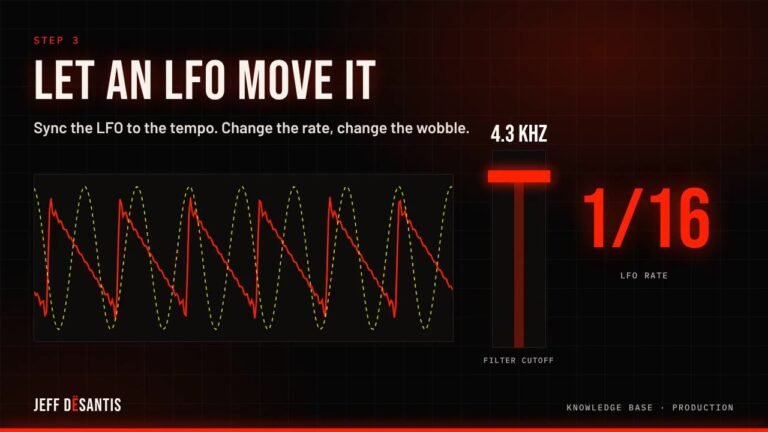 Music production · Video + audioHow to Make a Wobble Bass: Saw, Filter and LFO ExplainedThe three-part recipe behind dubstep wobbles, with a video and audio clips of every LFO rate from 1/4 to 1/16.Watch & read →