- House: kick on every beat (four-on-the-floor), claps on 2 and 4, open hats on the offbeats. Around 120-128 BPM.
- Dubstep: half-time. Kick on 1, snare on 3, written around 140 BPM so it feels like 70.
- Trap (EDM): half-time snare, a bouncing 808 and fast hats with rolls, around 140 BPM.
- Moombahton: the reggaeton dembow over a steady kick, around 100-110 BPM.
Genres are mostly decided by where the drums land. Keep the same sounds, move a few hits on a 16-step grid, and house turns into dubstep or moombahton. The video runs all four patterns on the same sequencer so you can see and hear the difference.
Watch and listen
House · 128 BPM
Four-on-the-floor.Dubstep · 140 BPM
Half-time weight.Trap · 140 BPM
808 bounce + hat rolls.Moombahton · 105 BPM
Dembow bounce.How to read a 16-step grid
One bar of 4/4 split into 16 sixteenth notes. Steps 1, 5, 9 and 13 are the four beats. Steps 3, 7, 11 and 15 are the “ands” (offbeats). Everything below uses that numbering.
| Genre | Tempo | Kick | Snare / clap | Hats |
|---|---|---|---|---|
| House | 120-128 | 1, 5, 9, 13 | 5, 13 | Open hats on 3, 7, 11, 15 |
| Dubstep | 140-150 | 1 (plus a pickup, e.g. 11) | 9 | 8ths |
| Trap (EDM) | 140-150 | 808 on 1, 8, 11 (varies) | 9 | 16ths with triplet rolls |
| Moombahton | 100-110 | 1, 5, 9, 13 | 4, 7, 12, 15 (dembow) | Offbeats + shaker |
House
The kick on every quarter note is the engine, which is why it is called four-on-the-floor. Claps on beats 2 and 4 give the backbeat, and an open hat on every offbeat gives that “tss” lift. Shakers or closed hats on all sixteen steps add drive. Swing the 16ths slightly and it grooves instead of marching.
Dubstep
Dubstep is written around 140 BPM but the snare lands on beat 3 instead of 2 and 4, so it feels half as fast. That space is deliberate: it leaves room for the sub and the bass sounds. A second kick just before the snare is a common pickup. Read more in what is dubstep.
Half-time trick: because 140 is double 70, dubstep and trap patterns mix into 70-ish hip-hop grooves and back. See the BPM chart by genre.
Trap
EDM trap keeps the half-time snare but swaps the kick for a long, tuned 808 that follows the bassline. The hats are where the personality is: steady 16ths with bursts of triplet rolls at the end of phrases, often pitched up or down. Keep the 808 in key with your track or it will clash with the bass.
Moombahton
Moombahton puts the reggaeton dembow on top of a house-style kick at 100-110 BPM. The dembow is a syncopated snare pattern that, together with the kick, gives the famous “boom-ch-boom-chick” bounce, built on a 3+3+2 feel. It takes its name from Shabba Ranks’ 1990 dancehall track “Dem Bow”. In the grid above, the snare hits steps 4, 7, 12 and 15. Read the full story in what is moombahton.
Try it in 10 minutes
Program the house pattern at 128 BPM. Now, without changing sounds, move the snare to step 9 only, delete kicks 5, 9 and 13, and set the tempo to 140. You just turned house into dubstep.
Got the trap pattern down? Learn how to tune an 808 to your key and make it slide, with video and A/B audio.
FAQ
What is four-on-the-floor?
A kick drum on every beat of a 4/4 bar. It is the foundation of house, techno and most dance music.
What makes dubstep drums half-time?
The snare lands on beat 3 instead of beats 2 and 4, so a 140 BPM track feels like 70 BPM.
What is the dembow rhythm?
The syncopated kick-and-snare pattern behind reggaeton and moombahton, named after Shabba Ranks’ 1990 song “Dem Bow”.
What BPM is trap?
EDM trap is usually written around 140-150 BPM with half-time drums. Hip-hop trap is often described at 70-80 BPM or double-time equivalents.
Sources: Wikipedia, Dembow beat · MusicRadar, How to make a reggaeton beat · Mixgraph, What BPM is dubstep? · Beat Kitchen, The genre landscape
// More guides
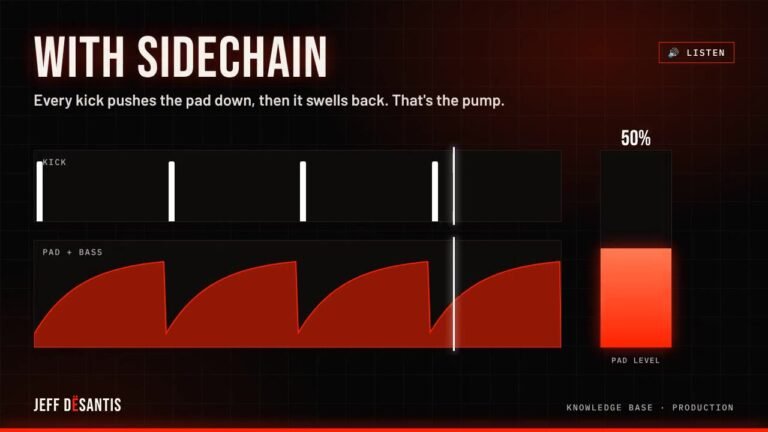 Music production · Video + audioSidechain Compression Explained: How to Get the EDM PumpHear the difference: what sidechain compression does, why every EDM drop pumps, and the four settings that control it.Watch & read →
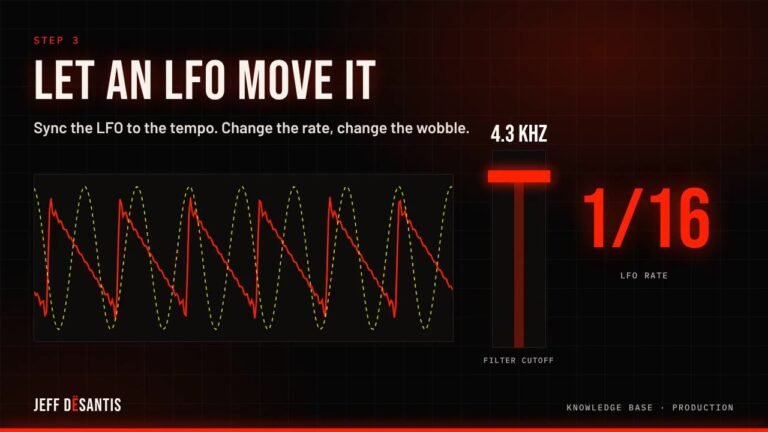 Music production · Video + audioHow to Make a Wobble Bass: Saw, Filter and LFO ExplainedThe three-part recipe behind dubstep wobbles, with a video and audio clips of every LFO rate from 1/4 to 1/16.Watch & read →
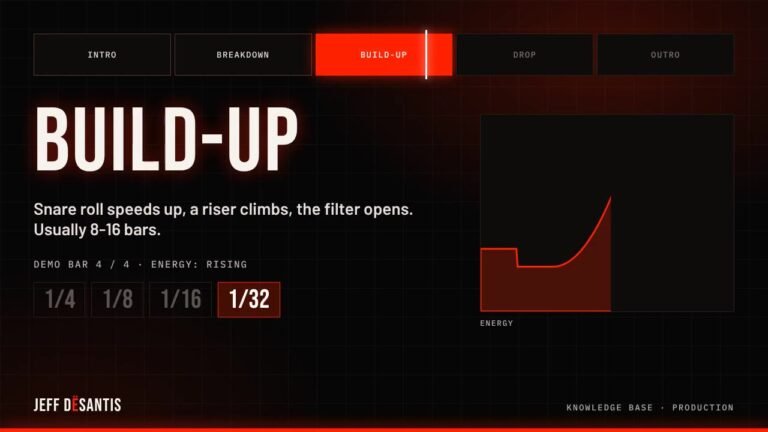 Music production · Video + audioAnatomy of a Drop: EDM Song Structure Bar by BarIntro, breakdown, build-up, drop, outro: hear every section in a 30-second demo and learn how many bars each one runs.Watch & read →