- A Reese bass is two (or more) saw waves tuned slightly apart, so they drift in and out of phase and the bass moves on its own.
- Recipe: detune two saws, low-pass the fizz, sweep the cutoff slowly, then add grit if the track needs it.
- Keep everything under about 120 Hz mono and let a clean sine sub carry the low end.
If you want to know how to make a Reese bass, the good news is it’s one of the simplest sounds in electronic music: two saw waves, a tiny bit out of tune with each other. That small detune makes the bass swirl, phase and growl by itself, with no LFO needed. I built one from scratch for this guide at 128 BPM in F minor, so you can watch it come together and hear every step.
Watch and listen
A. One saw
Bright and buzzy, but static.B. Two detuned saws
Same notes, 12 cents apart: now it moves.C. Low-pass sweep
The fizz is tamed and the cutoff breathes.D. Full Reese
Grit, mono sub, sidechain and drums.What a Reese bass is (and where it came from)
The name comes from Kevin Saunderson, who released “Just Want Another Chance” in 1988 under the alias Reese. Its warbling bassline was made on a Casio CZ synth (Saunderson has named the CZ-5000 in one interview and said in another he can’t remember which CZ model it was). Because one version of the record had the bass almost on its own, it was easy to sample, and Renegade’s “Terrorist” in 1994 turned it into a jungle and drum and bass staple.
From there it spread into techstep and neurofunk, UK garage, dubstep and neuro, and today producers use “Reese” for pretty much any stacked, detuned saw bass. The core idea never changed: constant movement from oscillators that are almost, but not quite, in tune.
How to make a Reese bass in 4 steps
Start with one saw, mono, with glide
Set your synth to mono (one note at a time) and pick a sawtooth. Turn on legato and a little glide so notes slide into each other. On its own this sounds flat, which is the point: you’ll hear exactly what the next step adds.
Add a second saw and detune it
Copy the saw to a second oscillator and pull them apart: one slightly sharp, one slightly flat. In the video I used 12 cents each way. The two waves now line up, cancel, and line up again, and you hear that as the slow swirl. More detune means faster, wilder movement; less means a slow, lazy phase. Some producers drop the second oscillator an octave or use a square for more body.
Low-pass it and move the cutoff slowly
Raw detuned saws are fizzy. A low-pass filter takes the top off, and a slow cutoff sweep (an LFO synced to a bar or two, or a hand-drawn automation lane) makes the bass breathe. This is different from a wobble bass, where a fast tempo-synced LFO is the whole effect.
Add grit, then fix the low end
Distortion or saturation brings out the mids, which is where a Reese cuts through on club speakers. Then high-pass the Reese around 120 Hz, put a clean sine sub underneath, and duck both to the kick.
Starting settings
These are the settings from my demo, a starting point rather than rules. Tweak by ear.
| Control | Start here | What it does |
|---|---|---|
| Oscillators | 2 saws, mono voice | Two waves to beat against each other |
| Detune | About 10-15 cents each way | Speed and depth of the swirl |
| Glide | Legato on, short glide | Notes slide instead of retriggering |
| Low-pass cutoff | Sweep roughly 300 Hz to 1.6 kHz | How bright or dark the bass gets |
| Sweep rate | 1-2 bars | Slow breathing movement |
| Mono below | About 120 Hz | Keeps the low end solid on club systems |
Watch the low end. Detuned oscillators, chorus and stereo wideners all play with phase. Down in the sub that can make the bass thin out or disappear in mono. Keep the wide, swirly part above the sub and the sub itself centered.
Make the Reese bass fit the mix
A Reese takes up a lot of room in the low mids, so it fights the kick for space. Two fixes do most of the work. First, a clean sub: a plain sine an octave below the Reese notes carries the weight, and the Reese only has to handle character. Second, sidechain compression so both bass layers dip each time the kick hits. You can hear the difference between clip C and clip D above.
For DJ-friendly tracks I keep the Reese phrases in clean 8 or 16 bar blocks so the bass change lands where a DJ expects it. If you want to see how that fits the whole track, the anatomy of a drop guide walks through structure bar by bar.
Try it in 10 minutes
Write a four-bar bassline with one long note per bar (F, Db, Ab, Eb works). Play it with one saw, then add a second saw detuned 12 cents each way and compare. Add a low-pass sweep over two bars, then high-pass the bass at 120 Hz and put a sine sub underneath. Bounce both versions and A/B them like the players above.
FAQ
What is a Reese bass?
A bass made from two or more saw waves detuned slightly from each other, so they drift in and out of phase and create a moving, growling tone. It’s named after Kevin Saunderson’s 1988 track released under the alias Reese.
How many cents should I detune a Reese bass?
There’s no single number. Small amounts (around 10-15 cents each way) give a slow, smooth swirl; bigger amounts give faster, more aggressive movement. Set it by ear on the notes you’re actually playing.
Should a Reese bass be mono or stereo?
Both. Keep the sub and everything below about 120 Hz mono, and let the detuned, wider part sit above that.
What is the difference between a Reese and a wobble bass?
A Reese moves because its oscillators are out of tune with each other. A wobble moves because an LFO opens and closes the filter in time with the track.
Sources: Mixmag: How Kevin Saunderson’s Reese bassline transformed UK dance music · Splice: Exploring the history of the Reese bass · LANDR: The Reese Bass, everything you need to know · MusicRadar: How to create a classic old-school Reese bass sound
// More guides
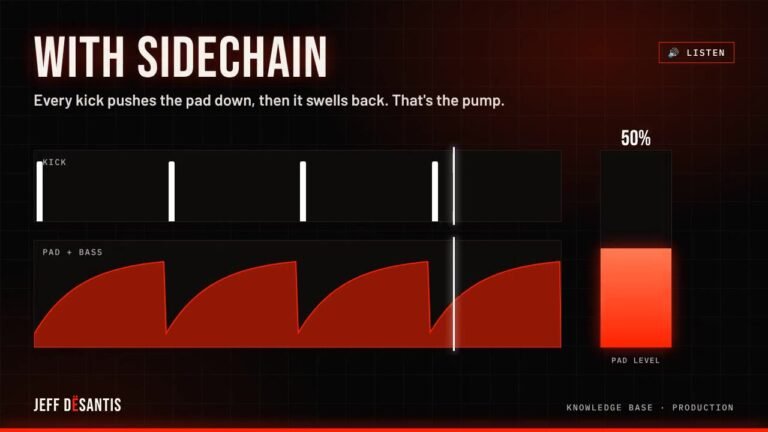 Music production · Video + audioSidechain Compression Explained: How to Get the EDM PumpHear the difference: what sidechain compression does, why every EDM drop pumps, and the four settings that control it.Watch & read →
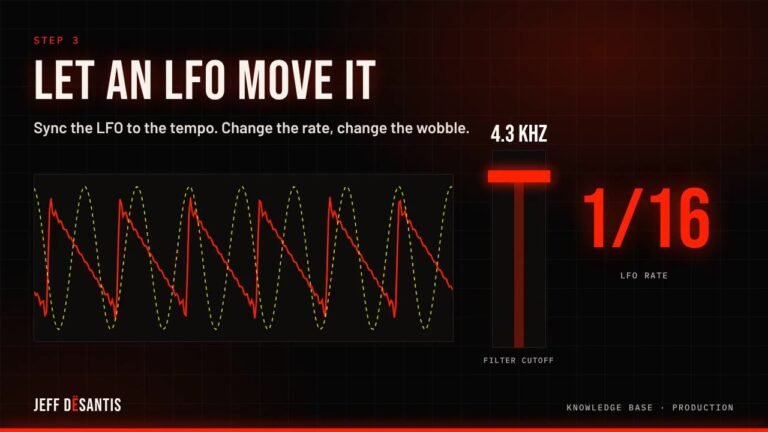 Music production · Video + audioHow to Make a Wobble Bass: Saw, Filter and LFO ExplainedThe three-part recipe behind dubstep wobbles, with a video and audio clips of every LFO rate from 1/4 to 1/16.Watch & read →
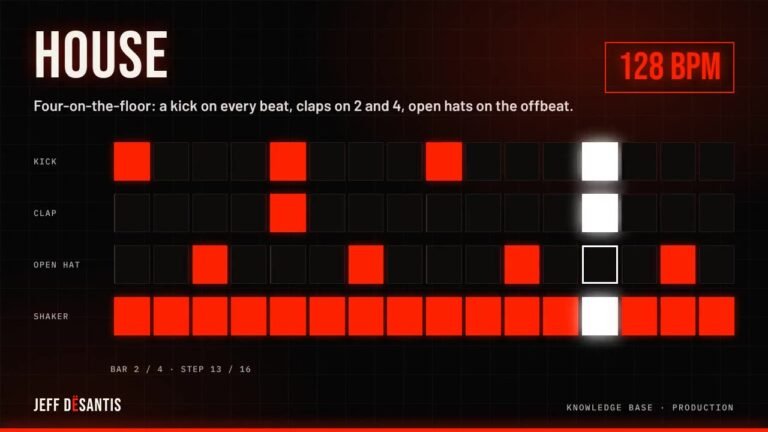 Music production · Video + audioDrum Patterns by Genre: House, Dubstep, Trap and MoombahtonThe 16-step drum patterns behind four genres, with a step-sequencer video and audio loops you can play.Watch & read →