- To tune an 808, find its root note (tuner plugin or spectrum analyzer, then your ears) and transpose it to the key of your song, usually the root note of the key.
- Then write the 808 like a bassline: it plays the root of each chord, so the sub and the chords agree.
- For slides, set the 808 to mono (one voice) with glide/portamento in legato mode, and overlap two notes. The pitch bends from the first note to the second.
- Finish with saturation so it reads on small speakers and a clean-up of the rumble below roughly 25-30 Hz.
An 808 is a drum and a bass note at the same time, and that is exactly why it causes trouble. If you have ever had a beat where the low end feels muddy or “off” and no EQ move fixes it, the 808 is probably playing the wrong note. Here is how to tune an 808 to your song, make it follow the chords, and then make it slide like a proper trap or bass music 808, with a video and A/B clips so you can hear every step.
Watch and listen
A. Untuned 808
Sample root around 49.5 Hz (near G1) over an F minor chord.B. Tuned to F
Same pattern, root moved to F1 (43.65 Hz). It locks in.C. Glide off
F1 up to F2 and back, every note retriggers and jumps.D. Glide on
Same notes, overlapped in mono legato with a 90 ms glide.Why an out-of-tune 808 sounds wrong
A normal kick is over in a split second, so its pitch barely matters. An 808 rings out with a long, pitched sub tone, which means it behaves like a bass note. If that note is not in your key, it fights the chords and the bassline for the whole length of the tail.
The catch is that 808 samples rarely arrive in your key. MusicRadar notes that the original TR-808 kick was meant to sit around 56 Hz, a slightly sharp A, but real machines drifted from unit to unit. A 2025 study that measured a library of TR-808 samples found a median fundamental near 49.5 Hz, close to G1. So if you drop a random 808 into a track in F minor, there is a good chance it is sitting a couple of semitones away from where it should be. That is clip A above.
How to tune an 808 in 4 steps
Find the 808’s note
Put a tuner plugin or a spectrum analyzer on the 808 and play one long hit. Look for the strongest low peak, not the click at the start. Sound On Sound’s advice is not to trust a tuner blindly on drums, so confirm it by playing a sine or bass note alongside and listening for beating.
Transpose it to the key
Shift the sample to the root note of your key (F for F minor) in your sampler or with the clip’s transpose control. iZotope suggests moving to the closest note in the key, because big pitch shifts add artifacts. If you are in Ableton’s Simpler, transposing in Classic mode works well.
Play it like a bassline
Once the sample is in tune, load it into a sampler that tracks the keyboard and write MIDI notes. In the video I play the roots of Fm, Db, Ab and Eb, and the 808 moves with each chord. Stick to notes in the key.
Check the low end with your ears
Loop the drop and listen on headphones and a phone speaker. A tuned 808 sounds bigger without getting louder, because it reinforces the chords instead of rubbing against them.
Tip: if a sample sounds weak after you pitch it way down, go up an octave instead. The same study found that moving an 808 down a fourth costs several decibels of perceived loudness on studio monitors, while harmonics from saturation help it survive.
808 note frequency chart
These are the sub-bass notes most 808s live on, in standard tuning (A4 = 440 Hz, equal temperament). The last column shows which ones belong to F minor, the key of the demo.
| Note | Frequency | In F minor? |
|---|---|---|
| F1 | 43.65 Hz | Yes (root) |
| F#1 / Gb1 | 46.25 Hz | No |
| G1 | 49.00 Hz | Yes |
| G#1 / Ab1 | 51.91 Hz | Yes |
| A1 | 55.00 Hz | No |
| A#1 / Bb1 | 58.27 Hz | Yes |
| B1 | 61.74 Hz | No |
| C2 | 65.41 Hz | Yes |
| C#2 / Db2 | 69.30 Hz | Yes |
| D2 | 73.42 Hz | No |
| D#2 / Eb2 | 77.78 Hz | Yes |
| E2 | 82.41 Hz | No |
808 glide and slides
Slides are the 808 bending from one note to the next instead of jumping. They are all over trap, and they work in bass house and dubstep too. The recipe is the same in FL Studio, Ableton or Logic:
- Mono, one voice. Set polyphony to 1 so a new note takes over the old one.
- Glide/portamento on, legato mode. Legato means the glide only happens when notes overlap.
- Overlap the notes. Drag the end of the first note over the start of the next. Violet Recording points out that even a 16th of overlap is enough.
- Set the glide time by ear. Shorter feels snappy, longer feels lazy and dramatic. I used 90 ms in the demo; try it and adjust.
Two mix moves keep slides clean. First, a big upward slide gets louder as it climbs into a more audible range, so a small volume dip on that note helps. Second, saturate the 808 a little so its harmonics carry the pitch on phone speakers, then clean out the rumble at the very bottom (MusicRadar suggests below about 20-25 Hz, Violet Recording about 30 Hz). If a kick plays with the 808, sidechain compression lets the kick punch through. For the drums around it, see drum patterns by genre, and if you like this kind of low end, how to make a Reese bass is the next step.
Try it in 10 minutes
Grab any 808 sample, check its note with a tuner, and transpose it to the root of your track. Write four bars that follow your chord roots, one or two hits per bar. Then set the sampler to mono with glide on, overlap one note per bar into the octave above, and bounce both versions. A/B them like the players above, and grab my free DJ pack if you want something to test them against.
FAQ
What key should my 808 be in?
The same key as the song. Tune the 808 sample so its root note is the root of the key (F for F minor), then play other notes from the key as the chords change.
How do I find what note my 808 is?
Use a tuner plugin or a spectrum analyzer on a long 808 hit and read the lowest strong peak. Then check by ear against a sine or bass note, because tuners can misread drums.
Why doesn’t my 808 glide?
Usually the sampler is not in mono, glide or portamento is off, or the notes do not overlap. Set one voice, turn on glide in legato mode, and drag the first note over the start of the next.
Should the 808 and the kick be the same note?
If they play together, tune both to the key so they do not clash, and use a punchier kick or sidechain so the kick’s attack cuts through the 808.
Sources: MusicRadar: How to get the perfect 808s · arXiv (2025): Harmonic and transposition constraints of the TR-808 bass drum · Sound On Sound: How do I tune my kick-drum samples? · iZotope: How to tune drum samples · Violet Recording: How to make 808 slides
// More guides
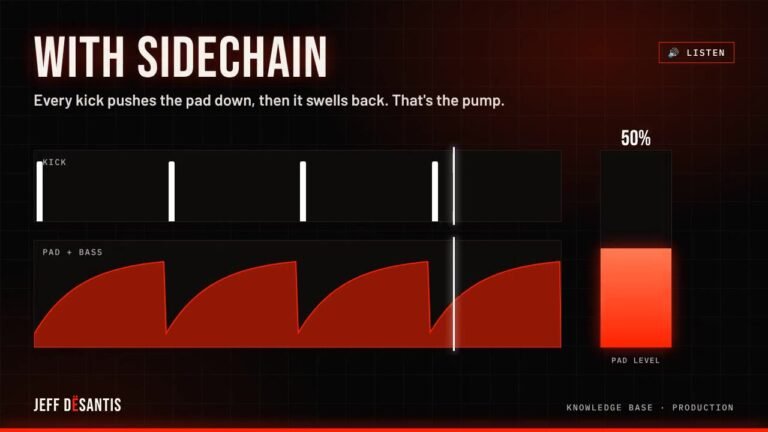 Music production · Video + audioSidechain Compression Explained: How to Get the EDM PumpHear the difference: what sidechain compression does, why every EDM drop pumps, and the four settings that control it.Watch & read →
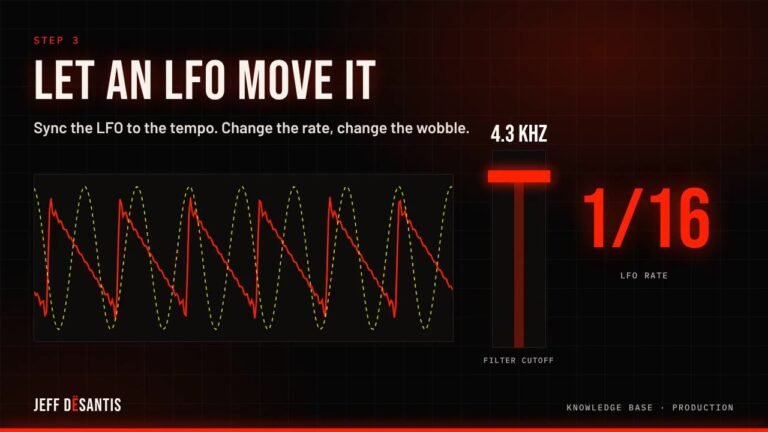 Music production · Video + audioHow to Make a Wobble Bass: Saw, Filter and LFO ExplainedThe three-part recipe behind dubstep wobbles, with a video and audio clips of every LFO rate from 1/4 to 1/16.Watch & read →
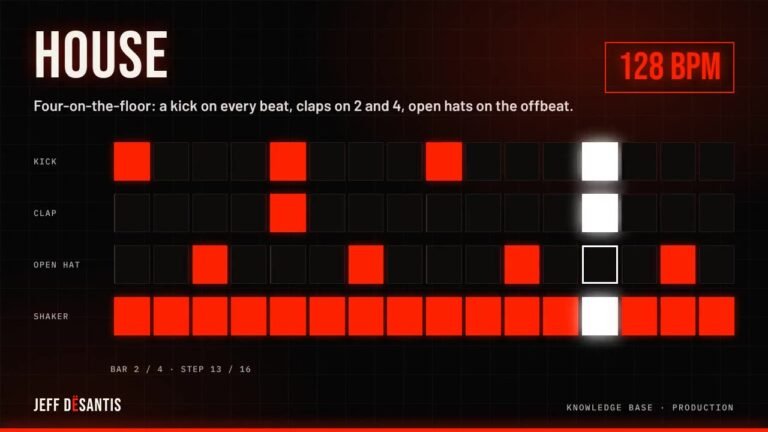 Music production · Video + audioDrum Patterns by Genre: House, Dubstep, Trap and MoombahtonThe 16-step drum patterns behind four genres, with a step-sequencer video and audio loops you can play.Watch & read →